

On this page
- Is there one nail technician license for the whole United States?
- How do you get a nail tech license step by step?
- What are the nail tech license requirements by state?
- How long does it take to become a licensed nail technician?
- How much does a nail tech license cost?
- Can you get a nail tech license online?
- What is on a nail technician licensing exam?
- Can you transfer a nail license to another state?
- What if you trained outside the United States?
- Can a 16- or 17-year-old get a nail tech license?
- Can Oh!Nice SPACE help you become licensed?
- How do you choose a legitimate nail technician school?
- What mistakes delay nail tech licensing?
- Treating a course certificate as a license
- Enrolling before checking board approval
- Following requirements from the wrong state
- Working while an application is pending
- Forgetting the business side
- Assuming reciprocity is automatic
- Final checklist
- Sources
- Frequently Asked Questions
There is no federal nail technician license in the United States. You must qualify under the rules of the state where you plan to work, and the credential may be called Nail Technician, Manicurist, Nail Specialty, or Nail Specialist Registration. The usual path is to complete a state-approved program, pass the examinations required by that state, submit an application and fee, and wait until the license is issued before providing paid services.
Licensing rules change. This guide was checked against official government sources on November 5, 2026. Confirm the current requirements with your state board before paying a school or scheduling an exam.
Quick answer:
- A course completion certificate is not the same as a state license.
- Training requirements differ sharply. The official examples checked for this guide range from 150 school hours in Virginia to 600 hours in Texas and Washington.
- Many states require both theory and practical exams. Florida requires a 180-hour nail program and a four-hour HIV/AIDS course for Nail Specialist registration, but it does not require the Florida cosmetology examination for that registration.
- Online study counts only when the state board accepts the school, program, delivery method, and completed hours. A hobby course cannot create exam eligibility by itself.
- An individual practitioner license may not be enough to open or operate a salon. Business, establishment, zoning, tax, and local health requirements can be separate.
- Oh!Nice SPACE nail courses are personal-education programs for ages 11 to 17. They do not provide a professional certificate, supervised licensing hours, exam eligibility, or a state license.
Is there one nail technician license for the whole United States?
No. Nail licensing is controlled by states, not by one federal agency. The U.S. Bureau of Labor Statistics says state requirements vary but usually include a state-approved cosmetology or nail technician program and a state examination.
Even the credential name changes. California and Texas use Manicurist. New York uses Nail Specialty. Florida registers Nail Specialists. Georgia, Illinois, and Virginia use Nail Technician. The phrase “master manicurist” is not a universal national license category, so do not choose a school or application based on that phrase alone.
Start with the regulator for the state where you expect to serve clients. The NIC state-board map links to cosmetology regulators and test administrators across U.S. jurisdictions. CareerOneStop also has a state License Finder, but its own help page warns that state submissions may be incomplete. The state board remains the final source.
How do you get a nail tech license step by step?
The exact forms differ, but the decision path is consistent.
- Choose the state where you plan to work. Use the rules for the work location, not your current address, favorite online school, or another state’s social media advice.
- Find the correct credential and scope of practice. Confirm whether the state calls it Nail Technician, Manicurist, Nail Specialty, or Nail Specialist Registration. Read what services that credential permits.
- Check age and education prerequisites. Some states accept applicants at 16, while several common examples require age 17. A grade level, high school diploma, equivalent education, medical form, or background review may also apply.
- Choose a board-approved school or accepted apprenticeship. Verify the exact school and program in the board’s own directory before paying. A school’s general accreditation, business license, or online certificate does not automatically make its nail program acceptable for state licensing.
- Complete the required curriculum and hours. Keep your enrollment agreement, transcript, completion certificate, payment records, and any apprenticeship logs. Your board may require the school or supervisor to send records directly.
- Apply for examination eligibility if your state uses exams. Follow the state board’s instructions for its current test provider. The board may use NIC examinations, a state examination, or another approved format.
- Pass every required examination. Depending on the state, this may include theory, practical, or written-practical testing. Do not assume that passing a school final examination replaces the state licensing examination.
- Submit the license application, supporting documents, and fees. Complete any background, identity, health, or additional-course requirements named by the state.
- Wait for the license or authorized temporary credential. Finishing school or passing an exam does not always authorize paid work. California’s board, for example, says applicants cannot perform services for a fee until they pass the written examination and the license is issued.
- Check salon and local business rules separately. A personal license authorizes your professional practice. A salon, booth, home studio, mobile service, or business may need additional state and local approvals.
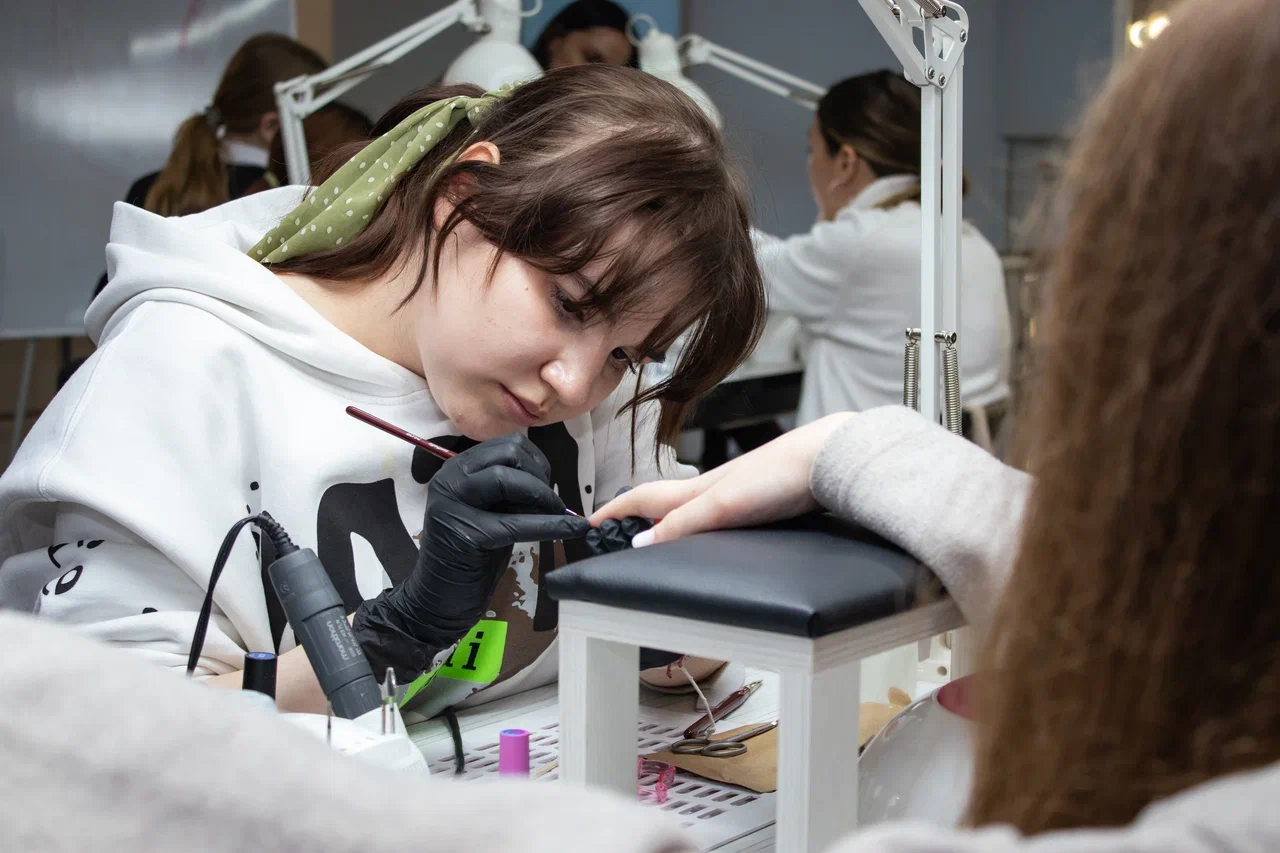
Gel Polish course classroom at Oh!Nice SPACE. The photo shows supervised skill practice; this course does not provide U.S. licensing hours or exam eligibility.
What are the nail tech license requirements by state?
The following comparison shows why a nationwide answer cannot be reduced to one number. It is a set of official examples, not a replacement for checking your own state.
| State | Credential | Minimum education or training | Examination | Other requirements highlighted by the state |
|---|---|---|---|---|
| California | Manicurist | 400 hours | Written examination | Age 17; completed 10th grade or equivalent. California Board |
| Florida | Nail Specialist Registration | 180 school hours | No Florida cosmetology examination for this registration | Age 16 or high school diploma; four-hour HIV/AIDS course completed within two years of application. Florida DBPR |
| Georgia | Nail Technician | 525 school hours over at least four months, or 1,050 apprenticeship hours over at least eight months | Written and practical examinations | The application must include required documents and fees. Georgia rules |
| Illinois | Nail Technician | 350 clock hours | Nail technology examination | Training must come from a licensed school approved to teach nail technology. Illinois IDFPR |
| New York | Nail Specialty | 250 approved-course hours | Written and practical examinations | Age 17; health certification; a one-hour awareness course for applicants qualifying through New York education. New York DOS |
| Texas | Manicurist | 600 hours | Written and practical examinations | Age 17; background check; $50 nonrefundable license application. Texas TDLR |
| Virginia | Nail Technician | 150 school hours or another accepted pathway | Theory and practical examinations | Approved Virginia training, registered apprenticeship, or an accepted equivalent pathway. Virginia DPOR |
| Washington | Manicurist | 600 school hours or 2,000 apprenticeship hours | Written and practical examinations | Age 17; all required hours and both exams must be completed before applying. Washington DOL |
Do not use this table to pick the “easiest” state if you intend to work elsewhere. A license normally governs practice in the issuing jurisdiction. Moving later can trigger an endorsement, reciprocity, equivalency, transcript, work-experience, or examination review.
How long does it take to become a licensed nail technician?
There is no national timeline. Start with the training requirement, then add the school’s schedule, examination availability, application processing, and any document review.
A 150-hour Virginia program can take much less calendar time than a 600-hour Texas program, but schools can schedule the same number of hours differently. Washington’s alternative apprenticeship requires 2,000 hours, compared with 600 hours at an approved school. Georgia’s rules describe 525 school hours over at least four months or an apprenticeship of at least eight months and 1,050 hours.
Ask every school for these dates in writing:
- first and last scheduled class date;
- weekly clock hours and attendance policy;
- dates when the school reports completed hours;
- earliest examination eligibility date;
- typical transcript processing time;
- refund and make-up-hour rules.
Do not convert training hours into weeks by dividing by a full-time schedule unless the school confirms that schedule. Holidays, absences, part-time enrollment, clinical rotations, and exam appointments can extend the process.
How much does a nail tech license cost?
There is no single U.S. price. Your total can include tuition, enrollment fees, books, a kit, uniforms, insurance, background checks, examination fees, the state application, and renewal. Some schools bundle these items, while others quote tuition only.
Government charges also differ. New York currently lists a $40 initial application fee, a $15 written exam fee, and a $15 practical exam fee. Its optional six-month temporary license costs $10. Texas lists a $50 nonrefundable application fee, with education and examination costs handled separately.
Before signing an enrollment agreement, request one written price sheet with:
| Cost item | Question to ask |
|---|---|
| Tuition | Is this the full price for every required clock hour? |
| Registration | Is the enrollment fee refundable? |
| Kit and supplies | Which products and implements are included? |
| Books and online platform | Are access fees one-time or recurring? |
| Examination | Is each attempt paid separately? |
| State application | Is the government fee included or paid directly? |
| Extra hours | What happens if you miss class or need additional practice? |
| Renewal | How often does the license renew, and is continuing education required? |
A low advertised tuition number is not useful if it excludes the kit, examinations, additional hours, or state application.
Can you get a nail tech license online?
You cannot assume that a general online nail course qualifies you for a state license. State boards approve specific schools, curricula, hours, and examination pathways. Nail education also includes hands-on procedures and infection-control practice.
Some approved schools may deliver certain theory lessons online if their regulator permits it. That does not mean an out-of-state video course, private certificate, or self-paced hobby class counts. Before enrolling, ask the state board to confirm all four points:
- Is the school currently approved for the exact nail credential?
- Is this specific program approved, not just the institution?
- Are online hours accepted, and is there a limit?
- Who reports your completed hours and makes you eligible for the examination or application?
If the school cannot show its listing on the regulator’s website, do not rely on a salesperson’s statement that the course is “certified.”
What is on a nail technician licensing exam?
The exam depends on the state and test provider. The National-Interstate Council of State Boards of Cosmetology offers Nail Technology theory, practical, and written-practical examinations, but each state or test administrator publishes the candidate bulletin that applies there.
Common subjects include:
- infection control, disinfection, blood-exposure procedures, and client protection;
- nail and skin anatomy;
- nail disorders, diseases, and conditions that prohibit a service;
- consultation and documentation;
- safe use of implements, equipment, and products;
- manicure and pedicure procedures;
- artificial nail services and product handling;
- state laws, rules, and professional conduct.
Download the current candidate bulletin from your board or its named test provider. Use its supply list, permitted products, timing, identification rules, and model or mannequin instructions. A generic exam video can be outdated or written for another state.
Can you transfer a nail license to another state?
Sometimes, but a license does not automatically travel with you. States may call the process endorsement, reciprocity, equivalence, or out-of-state licensure.
The receiving board may compare your original training hours, examinations, license status, and work experience with its current requirements. It may request a certification of licensure sent directly from the original board. It can also require extra education, another examination, or proof of recent lawful practice.
New York, for example, has separate pathways for endorsement, out-of-state education, prior licensing, and documented experience. California reviews out-of-state training against its current 400-hour manicurist requirement. Florida may endorse an active out-of-state registration or license when the other state’s requirements are equal to or greater than Florida’s requirements.
Contact the receiving board before moving, enrolling in extra classes, or letting the original license expire.
What if you trained outside the United States?
Foreign education and experience are reviewed state by state. Translated diplomas alone may not be enough. A board may request transcripts with subjects and hours, license verification from the country of training, credential evaluation, employment letters, tax records, or proof that the occupation was legally practiced.
New York’s official guide gives two useful examples. It may evaluate education completed outside New York or the United States when the applicant supplies a school certificate, transcript with subjects and hours, and licensing or hours verification. It also describes a separate route based on five years of legal experience outside New York. Those are New York pathways, not nationwide rules.
Ask the board which documents must be original, sealed, translated, notarized, or sent directly by another authority before paying for an evaluation.
Can a 16- or 17-year-old get a nail tech license?
It depends on the state. Florida accepts a Nail Specialist Registration applicant who is at least 16 or has received a high school diploma. California, New York, Texas, and Washington use age 17 in the official requirements checked for this guide.
A minor may still need an adult to sign a school contract, manage payment, or approve participation under the school’s policy. Age eligibility also does not remove education, hours, examination, or application requirements.
For a teen who is not yet eligible, the useful first step is career exploration: learn what nail work involves, practice safely on tips, compare state-approved schools, and understand sanitation before committing to tuition.
Can Oh!Nice SPACE help you become licensed?
Oh!Nice SPACE can help a teen explore nail skills before making a licensing-school decision. It cannot issue a professional credential.
The current Oh!Nice SPACE nail course hub offers three separate self-paced programs for ages 11 to 17:
- Nail Art and Safe Manicure: 18 lessons on nail anatomy, care, tools, hygiene, polish, and beginner designs;
- Gel Polish Manicure: 15 lessons, about 1.8 hours, covering workstation setup, safety, materials, e-file fundamentals, removal, overlays, leveling, and gel application;
- Nail Stamping: 10 lessons on tools, pattern transfer, reverse stamping, gradients, and shadow stamping.
Each course currently costs $15 as a one-time payment and includes lifetime access. An adult purchaser manages the account for a learner under 18.
These courses are for personal education and early career exploration. They do not provide state-approved clock hours, supervised clinical training, professional certification, examination eligibility, or a cosmetology license. A teen can use them to test whether detailed nail work feels enjoyable before a family pays for a state-approved professional program.
How do you choose a legitimate nail technician school?
Verify the school with the state board first. Then compare the program as a consumer.
Use this checklist before paying:
- The regulator lists the school as active and approved.
- The exact nail program qualifies for the credential you need.
- The enrollment agreement states the required clock hours and schedule.
- The school explains who reports completed hours to the board or test provider.
- The full price includes or identifies the kit, books, examinations, and application.
- The school provides its attendance, make-up, cancellation, refund, and transfer policies in writing.
- The curriculum includes sanitation, infection control, anatomy, contraindications, client consultation, and hands-on procedures.
- You know which examination vendor and candidate bulletin apply.
- You understand whether the program is portable if you move.
- The school does not promise a state license merely for buying or finishing its course.
If a program uses phrases such as “internationally certified,” “master certificate,” or “licensed course,” ask which government board recognizes it for the state application. Marketing language is not proof of eligibility.
What mistakes delay nail tech licensing?
Treating a course certificate as a license
A school certificate usually proves that you completed its program. The state license is a separate government credential.
Enrolling before checking board approval
Hours from an unapproved program may not count. Verify the exact program in the regulator’s current directory.
Following requirements from the wrong state
Training hours, age, exams, and credential names differ. Use the state where you plan to work.
Working while an application is pending
School completion, exam eligibility, and licensure are different statuses. Begin paid practice only when the state authorizes it through an issued license or valid temporary credential.
Forgetting the business side
An individual license may not authorize a home salon, booth, mobile business, or establishment. Check state salon rules plus city, county, tax, zoning, and insurance requirements.
Assuming reciprocity is automatic
Ask the receiving state for a written checklist before moving or paying for additional education.
Final checklist
- Choose the state where you will work.
- Find the correct government board and credential name.
- Verify age, education, health, and background requirements.
- Enroll only in an accepted school or apprenticeship.
- Keep transcripts, hour records, and completion documents.
- Use the current state or test-provider candidate bulletin.
- Pass every required examination.
- Submit the application and fees.
- Wait for authorization before performing paid services.
- Check salon, business, zoning, tax, and insurance rules separately.
The most important distinction is simple: learning nail skills, completing a program, passing an exam, and receiving a license are four different milestones. A trustworthy plan names each one.
Sources
- U.S. Bureau of Labor Statistics: Manicurists and Pedicurists
- NIC Testing: State regulators and exam providers
- California Board of Barbering and Cosmetology: License Requirements
- Florida DBPR: Nail Specialist Registration
- Georgia Secretary of State: Nail Technician Guide
- Georgia Rules: Nail Care Curriculum and Apprenticeship Requirements
- Illinois IDFPR: Nail Technology Qualifications
- New York Department of State: Nail Specialty License
- Texas TDLR: Apply for a Manicurist License
- Virginia DPOR: 2026 Licensing Requirements
- Washington State Department of Licensing: Cosmetology Licenses
By Irina Kolobovnikova, Nail Art Instructor. Licensing research and source verification by the Oh!Nice SPACE editorial team. This article provides general educational information, not legal advice.
Frequently Asked Questions
Do you need a license to do nails from home?
Often yes for paid nail services, but the exact rule depends on the state and service. A home-based salon may also need an establishment license, zoning approval, inspection, business registration, or other local permits. Check both the state cosmetology regulator and your city or county.
Is a nail certificate the same as a license?
No. A certificate can show course completion. A license is issued by a government regulator after you meet that jurisdiction's requirements.
Do all states require a practical exam?
No. The examination format varies. Texas, New York, Virginia, Washington, and Georgia require practical and written or theory testing in the official sources checked here. Florida does not require the Florida cosmetology examination for Nail Specialist registration.
What is the fastest state to get a nail tech license?
There is no responsible nationwide fastest-state answer. Required hours are only one part of the timeline, and a license from one state may not let you work in another. Choose the state where you intend to practice and compare approved programs there.
Can you work as a nail tech while waiting for your license?
Only if your state explicitly authorizes it through a valid temporary permit or another legal status. Do not rely on school completion alone. California says paid services cannot begin until the written examination is passed and the license is issued; New York has a separate temporary-license process for eligible applicants.
Does a cosmetology license include nail services?
It may, but scope varies. Some states authorize licensed cosmetologists to provide nail services without a separate nail credential. Confirm the scope stated by your board rather than assuming all cosmetology licenses are identical.
How often do nail tech licenses renew?
The renewal cycle and continuing-education rules vary by state. Texas says its Manicurist license is valid for two years. California says it does not require continuing-education credits to maintain the license. Other states can require specific renewal education or renewal dates.
What should you do first?
Open the official cosmetology or professional-licensing website for the state where you plan to work. Write down the credential name, approved training pathway, hours, examinations, age requirement, documents, fees, and renewal rules. Only then compare schools.